Special report · 1999 Carddass Hyper Battle
The First Stage Oda copyright error
Some cards in the first One Piece card set misprint Eiichiro Oda’s name as 尾田栄一朗 instead of 尾田栄一郎. About one in four audited PSA-graded copies carries it, on every design checked, and Bandai’s corrected art was in use by December 18, 1999.
Result · 180 PSA-graded First Stage cards audited
26.1%Error 朗 · 47 cards
73.9%Correct 郎 · 133 cards
- Every design checked
- Both spellings turn up on all eight designs audited, holo and non-foil.
- Corrected art by Dec 18, 1999
- A Bandai promo handed out at Jump Festa 2000 already reads 郎.
- First Stage only
- More than 50 later-stage cards checked. None carries the error.
Jump to: How to spot it · For collectors · All 180 certificates
Key findings
About one in four graded copies carries the misprint. 47 of 180 audited PSA certificates read 栄一朗. It is a share of graded copies, not a print-run figure.
SupportedIt shows up on every design checked. Both spellings appear on all eight designs audited, and no design stands out (p = 0.87). That points to the card back every First Stage card shares.
ConfirmedThe misprint came first. The vending header that advertised First Stage reads 栄一朗. A Bandai promo with the same back, handed out December 18 to 19, 1999, reads 郎, as does every later-stage card checked.
SupportedError copies turn up together. Cards graded in the same PSA submission tend to share a spelling, across designs. That fits cards bought from the same vending stock.
SupportedError copies may reach PSA 10 less often. 1 of 47 error copies is a PSA 10, against 16 of 133 correct copies. The gap could still be chance (p ≈ 0.07).
HintTwo questions remain open. When First Stage card printing switched to the corrected art, and whether every error card comes from one early run.
Open
Confirmed seen directly · Supported the evidence points this way · Hint suggestive, could be chance · Open not yet known
01 · How to spot it
Read the last character of Oda’s name on the back
Every First Stage card shares one back, with the copyright line under the ONE PIECE banner. On error copies the fifth character, just before the slash, has 月 on its right side instead of 阝.
Figure 1Two C01 Luffy cards, consecutive certificates, different spellings
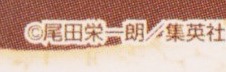
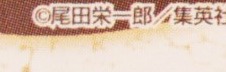
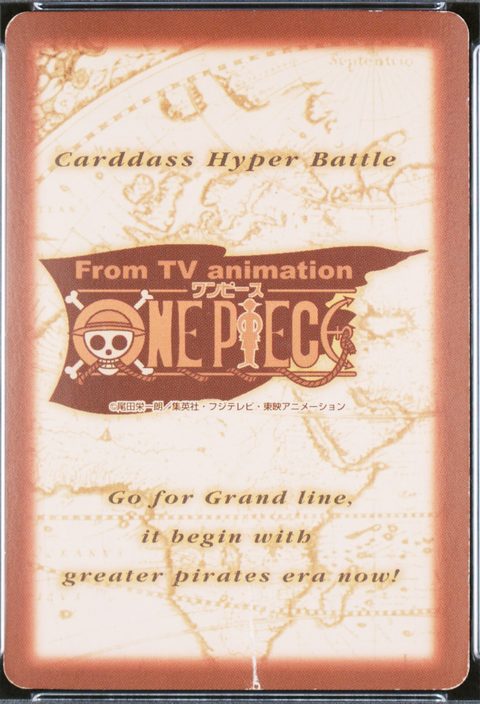
Where to look. The copyright line under the ONE PIECE banner, outlined. Every First Stage card shares this back.
- Graded cardOpen the certificate on psacard.com and read the back image. PSA does not list this as a variety, so the label won’t say.
- Raw cardAsk the seller for a sharp photo of the line under the banner.
- Later setsNo need to check. Every later-stage card checked reads 郎.
02 · Timeline
The misprint came first, and corrected art was out by mid-December 1999
Three dated sources bracket the change: the set’s own vending header, a Bandai promo from December 1999, and the sets that followed.
Figure 2The correction window
Nov 1999 · First Stage launch
Vending header reads 栄一朗
The artwork that advertised the set, with the same copyright line as the card back. Two copies checked, one graded by CGC.
Dec 18–19, 1999 · Jump Festa 2000
Promo C-J1 reads 郎
Bandai’s gift to booth visitors at Tokyo Big Sight, with the same back as First Stage. Every copy checked agrees, raw and graded.
Jan 2000 onward · Second Stage and later
Later stages read 郎
More than 50 cards checked from Second Stage onward. None carries the error.
Not yet known: when First Stage card printing switched to the corrected art, and whether every error card comes from one early run.
The header in detail
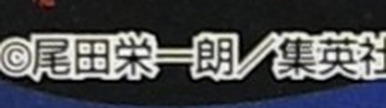
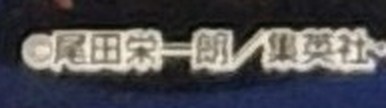
Each Carddass machine displayed a printed header advertising the set inside. The First Stage header shares the card back’s copyright element: the same typeface, separators and position under the From TV animation logo.
Figure 3The First Stage vending machine header, two copies
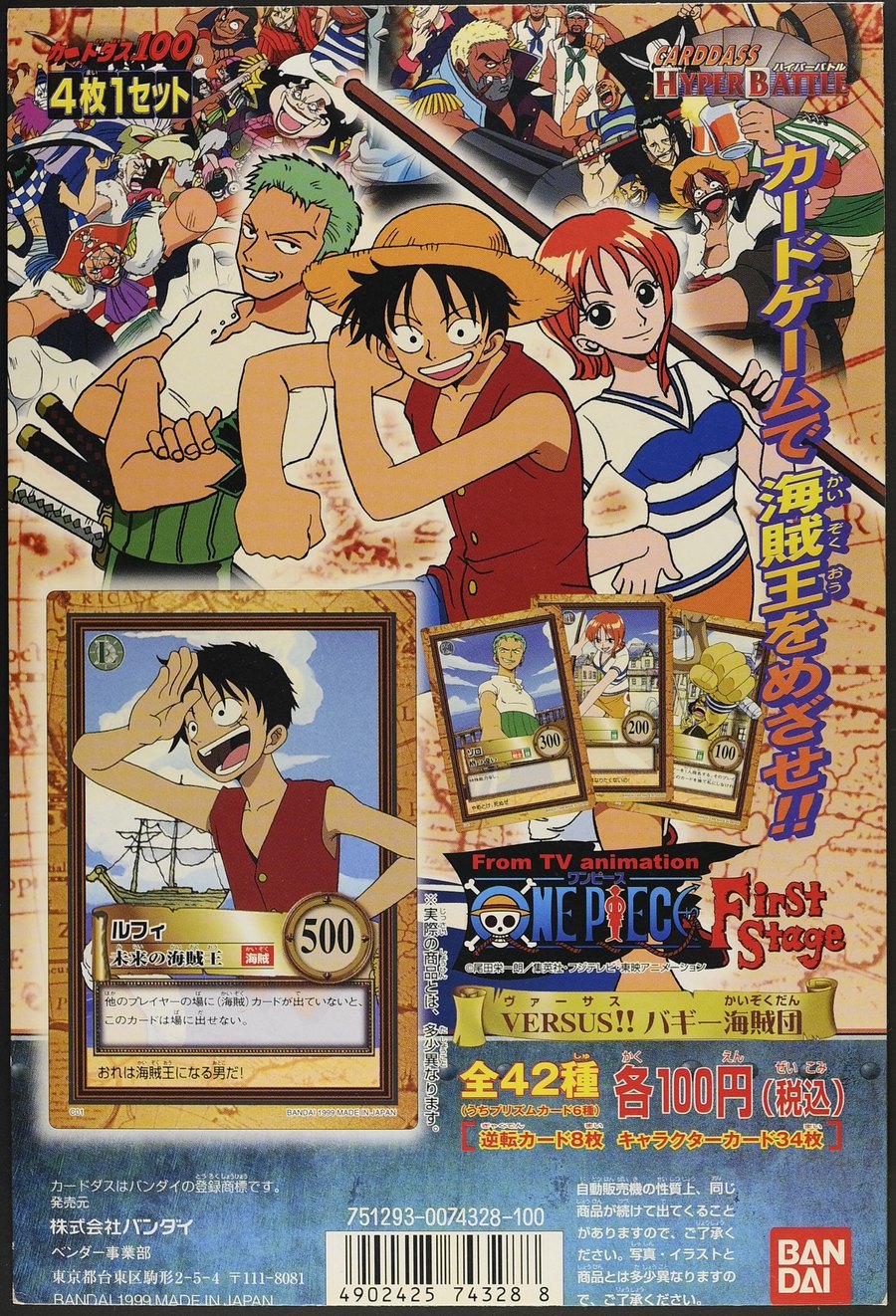
Flat scan
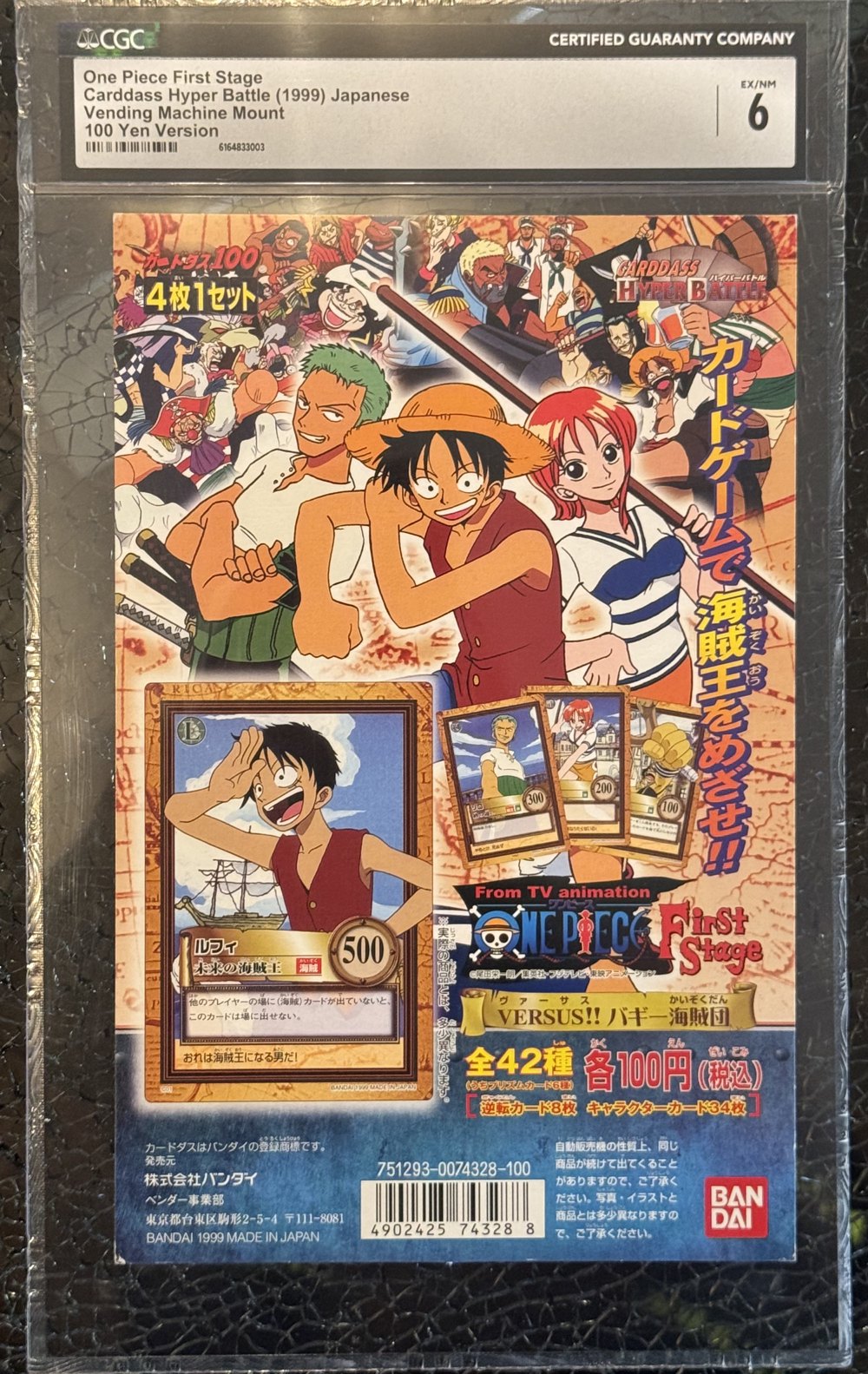
CGC EX/NM 6, cert 6164833003. Photo: mediagiraffes on Instagram
- Format
- Carddass 100 machine header: 4枚1セット, 全42種, 各100円(税込)
- Sold by
- 株式会社バンダイ ベンダー事業部, 東京都台東区駒形2-5-4
- Product code
- 751293-0074328-100
- JAN
- 4902425743288
- Imprint
- BANDAI 1999 MADE IN JAPAN
- Copyright
- ©尾田栄一朗/集英社・フジテレビ・東映アニメーション
One copy is a sharp flat scan. The other is graded CGC EX/NM 6 (cert 6164833003) and reads 朗 through the holder. Its product code and JAN match a separate copy listed on Yahoo! Auctions, and the JAN carries Bandai’s 4902425 prefix.
About First Stage Set facts, release date and how long it ran
First Stage, subtitled VERSUS!! Buggy Pirates (VERSUS!!バギー海賊団), opened Bandai’s Carddass Hyper Battle line. Grand Line Wiki lists it as the first official One Piece trading card set. It reached vending machines in November 1999, a few weeks after the TV anime premiered on Fuji TV on October 20, 1999, and its back carries the anime’s “From TV animation” logo.
- Released
- November 1999. No exact day has been published.
- Sold as
- Carddass 100 vending machines, ¥100 for 4 cards
- Cards
- 42 designs: 34 character cards (C01–C34) and 8 special cards (S01–S08)
- Holos
- 6 prism designs: C01 Luffy, C07 Zoro, C14 Shanks, C24 Buggy, S01 Luffy Pirates, S05 Nami. The other 36 are normal cards.
- Story
- Romance Dawn and Orange Town arcs
- Replaced by
- Second Stage, January 2000
A two-month window
Bars run from a set’s release month to the next vending set. Release months only; exact days aren’t published. Grand Box was a boxed deck, not a vending set.
Second Stage arrived in January 2000, so First Stage was the newest set in machines for about two months. Later stages followed every two to three months. Unsold First Stage cards could have stayed in machines longer, and no print-run figures are public.
03 · The numbers
One in four audited copies, spread evenly across the set
We read the copyright line on PSA’s own back scans of 180 graded First Stage cards, covering all six holo designs and two non-foil rookies. 47 carry the error. Allowing for sample size, the share among graded copies most likely sits between 20% and 33%: about three correct copies for every error copy.
Figure 4Every certificate in the audit, by design
No design stands out
Design rates run from 12.5% to 33.3%, all within chance of the pooled rate (chi-square, p = 0.87). The six holos come in at 27.1% (42 of 155) and the two non-foil designs at 20.0% (5 of 25). An even spread is what a change to the shared back would produce.
Figure 5Share of error copies by design, with 95% intervals
Fewer PSA 10s among error copies, possibly by chance
Error copies average PSA 7.45, against 7.92 for correct copies. One of 47 error copies is a 10, against 16 of 133: 2% against 12%. A gap this size would appear by chance about 7% of the time, so treat it as a hint.
Figure 6Grade distribution, as a share of each version
Show the counts
Error copies arrive together
PSA numbers certificates in order, so cards graded together sit close in number. Grouping certificates within 10 numbers of each other gives 28 groups of two or more cards. Six are all errors, against 1.3 expected by chance (p ≈ 0.0007). Inside groups, 10 of 34 pairs of different designs are both errors, against 2.4 expected (p ≈ 0.0002).
| Group | Certificate | Card | PSA |
|---|---|---|---|
| 1 | 109561478 | C14 Shanks | 8 |
| 109561480 | S05 Nami | 7 | |
| 2 | 149687222 | C07 Zoro | 7 |
| 149687224 | C24 Buggy | 8 | |
| 3 | 167756311 | C01 Luffy | 6 |
| 167756312 | C01 Luffy | 5 | |
| 4 | 169949186 | C01 Luffy | 9 |
| 169949187 | C07 Zoro | 8 | |
| 169949188 | S05 Nami | 9 | |
| 5 | 173947425 | C06 Zoro | 9 |
| 173947427 | C14 Shanks | 9 | |
| 173947428 | C24 Buggy | 9 | |
| 6 | 176050842 | C24 Buggy | 8 |
| 176050844 | S05 Nami | 7 |
The six all-error groups. Five of them mix designs.
That fits cards bought from the same vending stock. A refill box carries the whole set, so a box from an early lot would be all 朗 across designs; a sheet-position fault would mix both spellings in every box. Consecutive numbers show cards were graded together, not printed together, so the vending-stock link is an inference.
04 · Why it happened
Best explanation: a typo in the original art, corrected during the run
朗 and 郎 are both read rō and sit in the same row of the JIS character set (47-15 and 47-26), close together in typing conversion lists. 一朗 is also a common way to write Ichirō; Ichiro Suzuki’s legal name is 鈴木一朗. It is a plausible mechanism, not a documented one.
| # | Explanation | Verdict |
|---|---|---|
| 1 | Typo in the original art, corrected during the runHeader reads 朗; the December 1999 promo and later stages read 郎; the rate is even across designs. | Best supported |
| 2 | Two production streams, only one correctedA reprint lot or second printer kept the old art. Fits the clustering equally well; dated or regional evidence would separate it from the first. | Possible |
| 3 | The error came with licensor-supplied logo artThe copyright line travels with the anime logo. If so, other licensees’ late-1999 products would show it too. | Untested |
| 4 | A sheet-position or plate faultThe header carries the error, and errors cluster across designs. A fault in one part of a sheet would do neither. | Not supported |
| 5 | 郎 came first and 朗 laterThe header reads 朗. | Ruled out |
05 · For collectors
What it means for collectors
- Expect it on any First Stage design. Every card shares this back. Only 8 of 42 designs have been audited, and all eight have error copies.
- Ask about the rest of the lot. Error copies cluster. If a seller’s card reads 朗, their other First Stage cards may too.
- PSA 10 error copies are rare so far. One among 47 error copies in this sample, against 16 among 133 correct copies. The sample is small.
- Headers carry it too. Both First Stage vending headers checked read 栄一朗.
Help settle what’s open
- A First Stage header that reads 郎. It would point to a reprinted, later restock.
- A sealed box or a documented single-box lot. Under the leading explanation it should be one spelling throughout.
- Other licensees’ One Piece products from late 1999. If they read 栄一朗, the error came with the licensor’s art.
Have one of these, or an error copy of your own? Send the cert number or photos to @vintageonepiececards. Designs not yet covered help most.
06 · Method
Method, limits and sources
How we did it
- Collected 180 PSA certificates for eight of the set’s 42 designs: the six holos (C01 Luffy, C07 Zoro, S05 Nami, C14 Shanks, S01 Straw Hat Crew, C24 Buggy) and two non-foil rookies (C06 Zoro, C09 Nami). Each was matched to PSA’s record for card and grade.
- Read the copyright line on every card from PSA’s own back scan. A second, blind read of the first 179 found three error copies the first pass missed (below), each confirmed on PSA’s full-resolution scan.
- One certificate was reported by a collector after the error went public. Its back reads 朗 with the slab number visible, but it was not collected blind, so the appendix flags it “added later”. Without it the rate is 25.7%. It is also the sample’s only PSA 10 error copy.
- Intervals are 95% Wilson intervals. The design comparison is a chi-square test checked against 20,000 shuffles. Grade tests are shuffle tests run within each design.
- Group test: certificates sorted by number join a group when within 10 numbers of the previous one. All-error groups and cross-design error pairs were compared with 20,000 within-design shuffles (fixed seed), leaving out the added-later certificate.
- Header and promo: we read the copyright line on two First Stage headers (a flat scan, and a CGC copy through its holder), checked the header’s JAN check digit, and read the same line on several C-J1 promos, one in hand and the others, raw and graded, from photos.
| Certificate | Card | Grade | First pass | Corrected |
|---|---|---|---|---|
| 175777684 | S05 Nami | 8 | Correct | Error 朗 |
| 175894645 | S05 Nami | 8 | Correct | Error 朗 |
| 173947427 | C14 Shanks | 9 | Correct | Error 朗 |
Limits
- A sample of accessible PSA certificates with back scans, not a census or a print-run estimate. C01 Luffy makes up 64 of the 180.
- The first 179 cards were graded before the error was known, so submitters were not picking for it. Raw cards may differ.
- Eight of 42 designs are audited. The later-stage check covers more than 50 cards, not every design.
- PSA has not designated the error as a variety. The classification is ours.
- The header evidence rests on two copies. The header is dated only BANDAI 1999; treating it as launch art follows from its role as the set’s point-of-sale artwork.
- The group counts were chosen after seeing the data. Treat them as a strong indication, not proof.
- No Bandai notice or recall was found, and the 1999 print contractor is not documented.
Sources
- Certificates and back scans: PSA (Collectors Universe) records, linked from every square and appendix row. Certificate list: First Stage Copyright Registry.
- Set facts: Grand Line Wiki, Carddass Hyper Battle (1999–2002) for release months, pricing, card count and arcs; Satoshi Finds for the six prism designs; Wikipedia for the anime premiere.
- Dates: Wikipedia, Jump Festa for the Jump Festa 2000 dates and venue.
- Header and promo: CGC cert 6164833003; PSA cert 179273749 (C-J1); Yahoo! Auctions listings of the C-J1 promo and of First Stage headers (u1237002564, p1235833025).
- Vending terms: ヴィントコレクト, カードダス用語集 for the vending header (自販機台紙) and refill box contents.
Version history
- v2.0, November 8, 2026. Final report. Rewritten and restructured: a results summary, key findings with confidence labels, a timeline-first dating section, and one place for method, limits and sources. Statements about correction timing, production runs, the print-run share and PSA 10 scarcity now match the evidence. Certificate “batches” are now “groups”. Added section navigation. More C-J1 promos checked, raw and graded, and every one reads 郎. No certificate data or calculations changed.
- v1.2, November 7, 2026. Added the First Stage vending header (two copies, one CGC-graded) and the C-J1 Jump Festa 2000 promo. Together they put the error in the launch artwork and the fix before mid-December 1999. Re-ran the batch test with counts that look at error copies only, replacing the weak v1.1 result. Added the correction-window timeline, ranked explanations, the character-set mechanism, open questions, new limits and sources. Updated the summary, evidence table and collector notes. The page now leads with the dating evidence, and the card analysis follows it. No certificate data changed.
- v1.1, November 7, 2026. Added one collector-reported certificate, flagged “added later”.